
Living Funeral & Living Tribute Ceremonies
A gathering to say what matters, while there’s still time to say them.
Ruth turned eighty-two in March. By summer, the family had stopped waiting for a “someday” reunion and started asking a harder, kinder question: what if we gathered everyone now, while she could still hear every word?
That question is really the whole idea behind a living funeral. Not a rehearsal for grief, but a ceremony held on purpose, while the person being honored is still in the room to receive it.
What Is a Living Funeral, Exactly?
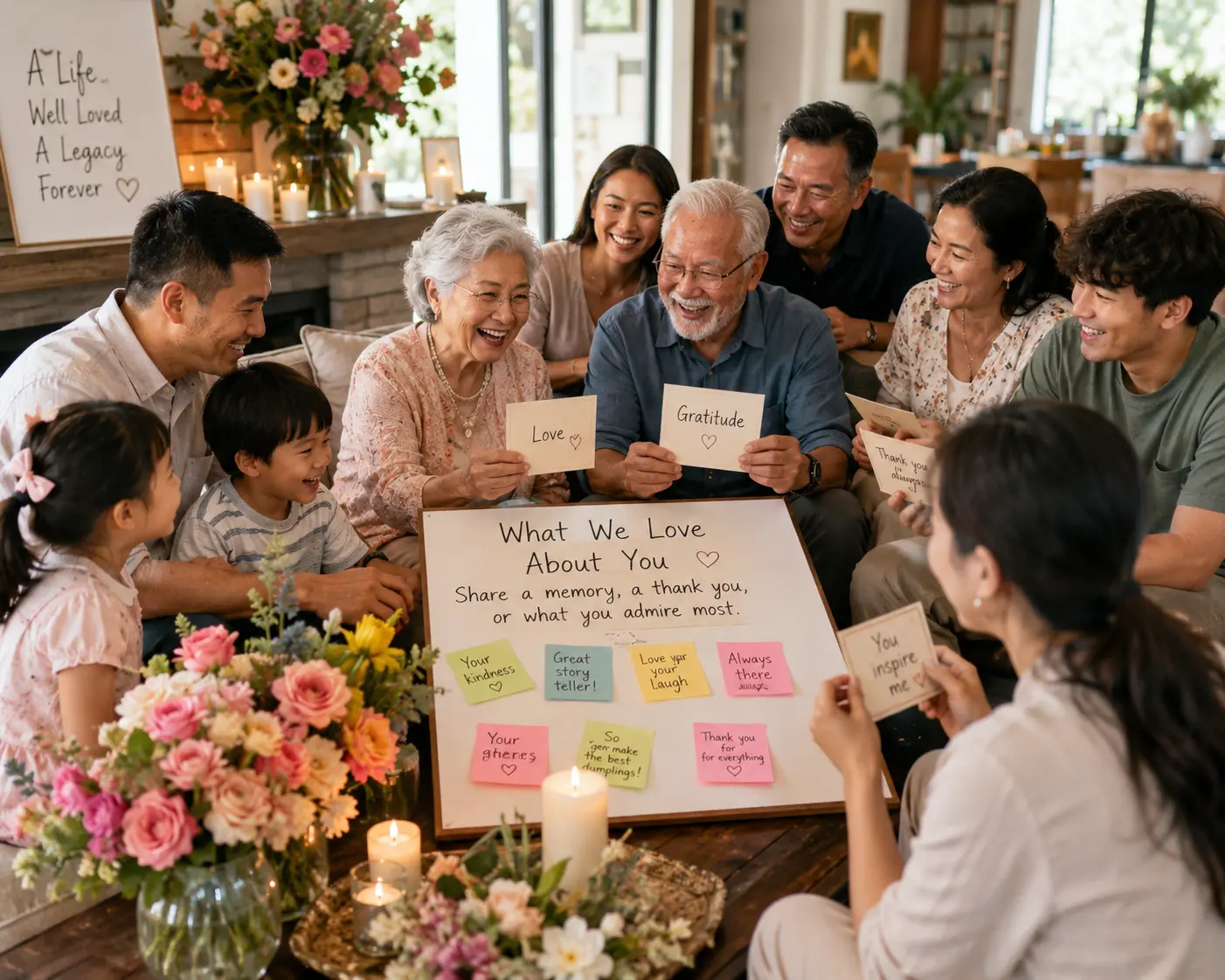
A living funeral is a ceremony held for someone while they are still alive — a gathering where family and friends share memories, gratitude, and love directly with the person, rather than about them after they’re gone. Some people call it a living tribute. Others call it a living wake. The name varies, but the intention is the same: don’t wait.
It isn’t a rehearsal, and it isn’t pretend. It’s simply a ceremony that moves the eulogy, the gratitude, and the stories to a moment when the person can still respond to them — laugh at the parts you got wrong, correct a detail, or just sit in a room full of people telling them, out loud, what they’ve meant.
Living Funeral, At a Glance
- Who it’s for: anyone facing a serious diagnosis, entering hospice, marking advanced age, or simply choosing not to wait
- What happens: stories, gratitude, readings, blessings, and time together — shaped like a ceremony, not a party or a support-group meeting
- Who leads it: a celebrant who has spent real time with the family beforehand, so the ceremony reflects their specific story
Why This Ceremony Is Gaining Attention Now
More hospice teams and end-of-life researchers have started documenting something families have quietly known for a long time: being present for your own tribute changes how people carry the time that’s left. A recent case report on a hospice patient’s living funeral, published through the National Institutes of Health, described a marked improvement in her mood and social engagement in the weeks following her ceremony — the gathering gave her something to look forward to, and a chance to feel connected rather than isolated by illness.1
That tracks with what I hear from families directly. The people who choose a living funeral aren’t trying to control their own send-off. They’re trying to be present for it — to hear the things people might otherwise save for a eulogy, and to say a few things back.
How a Living Funeral Differs From a Traditional Memorial
The structure can look surprisingly similar to a memorial service — readings, music, a few people sharing stories, a moment of reflection. The difference is who’s in the room and what that changes about the words themselves.
At a memorial, everything is spoken in past tense, to an absence. At a living funeral, the same stories are spoken directly to the person, in present tense, with room for them to respond. I write differently for the two. A memorial script holds space for grief that has nowhere else to go. A living funeral script holds space for a conversation that’s still possible — which changes not just the tone, but the structure of the ceremony itself.
What I Bring as Your Celebrant
I don’t walk into a living funeral and improvise. The process starts the same way every ceremony I write starts — with real conversation, well before the day itself.
How the process actually works
A story consultation, usually with the person being honored and whoever is closest to them, to understand what they’d want said, what they’d rather skip, and how much they want to know ahead of time.
A custom-written ceremony built around that conversation — not a fill-in-the-blank template, but language shaped specifically for this family, this history, this room.
Thoughtful delivery that reads the room as it happens. Living funerals move between laughter and tears faster than almost any ceremony I write, and part of my role is helping the room hold both without either one crowding the other out.
You can read more about how I approach this kind of work on my about page, where I talk about what led me to ceremony writing in the first place.
What a Living Funeral Ceremony Can Include
There’s no single script for this. A living funeral can be as intimate as five people around a kitchen table, or as full as a room of forty. What tends to stay consistent is the shape:
- An opening that names what the gathering is and gives people permission to feel more than one thing at once
- Stories and gratitude, spoken directly to the person, either read aloud by guests or gathered ahead of time and woven into the ceremony
- A blessing or reflection from the person being honored, if they want one — a chance to say something back
- A closing ritual — a shared toast, a piece of music, a moment of quiet — that marks the gathering as complete without needing to be final
I sometimes bring a live sound element into ceremonies like this — a single sustained tone that gives the room a moment to settle before the words begin. It’s optional, and it’s never the point. The point is always the people and what they came to say.
What Guests Should Know Before They Arrive
A living funeral asks something different of guests than a traditional memorial does, and it helps to say so ahead of time. People arrive with the instinct to be gentle, to keep things light, to avoid saying anything that sounds too final — and that instinct, left unchecked, can flatten the ceremony into small talk.
Part of what I do before a living funeral is send guests a short note on what to expect and how to prepare a story or a few words if they’d like to share one. It’s the same kind of guidance I give speakers before any ceremony — specific enough to steady someone who’s nervous about speaking, without ever handing them a script to read verbatim. The goal is always for the words to sound like the guest, not like me.
I also let guests know, gently, that it’s alright to say the true thing. Families often worry that naming the illness, the age, or the reason for the gathering out loud will upset the person being honored. In my experience, it’s almost always the opposite. Most people who choose a living funeral are relieved when the room stops tiptoeing and simply tells the truth, with love.
Is a Living Funeral Right for Your Family?
This ceremony fits more situations than people expect. Families come to me for a living funeral when:
- Someone has received a serious or terminal diagnosis and wants to gather loved ones while they’re able to fully take part
- A parent or grandparent is entering hospice and the family wants one more chance to say things out loud, together
- Someone reaching a significant age wants a gathering that isn’t tied to a milestone birthday, just to mark being here, now, with the people who matter
- A family has experienced estrangement or distance and wants a deliberate occasion to say what’s gone unsaid, while there’s still time
If any of that sounds like your family’s situation, it’s worth a conversation — not a commitment, just a conversation about whether this is the right shape for what you’re hoping to do.
Ruth’s family held her living funeral on a Saturday in early June, in her daughter’s backyard, with about twenty-five people and a table of the foods she used to make for every holiday. She corrected two stories that afternoon — both times, laughing. Near the end, she stood up on her own, without anyone asking her to, and told the room what forty years of showing up for each other had meant to her. Nobody in that yard left wondering whether she knew how loved she was.
That’s the whole reason this ceremony exists. Not to soften an ending, but to make sure the people who matter most get to hear it, and be heard, while they’re still together.
Let’s Talk About Your Ceremony
If you’re considering a living funeral for yourself or someone you love, I’d be glad to talk it through with you — no pressure, just a conversation about what might be possible.
Schedule a ConversationFrequently Asked Questions
Is a living funeral only for people who are terminally ill?
No. While many living funerals are held for people facing a serious diagnosis or in hospice care, families also choose this ceremony to mark advanced age, to repair distance after estrangement, or simply because they don’t want to wait for a traditional memorial to say what matters.
What do you call it if “living funeral” feels too heavy for my family?
I often use “living tribute” instead, especially when the person being honored isn’t seriously ill. The ceremony itself doesn’t change — only the language we use to introduce it to guests who might need a gentler entry point.
Will the ceremony feel sad the whole way through?
Not typically. Most living funerals move through a full range of emotion — there’s laughter, there are old stories nobody remembers correctly, and there’s real tenderness. A well-written ceremony makes room for all of it, rather than forcing a single tone.
Does the person being honored have to speak?
Not at all, though many choose to. Some people want to offer a blessing or reflection back to the room; others would rather simply receive what’s said and respond in their own way, or not respond at all. I always ask ahead of time and build the ceremony around what feels right for them.
How is this different from a birthday party or anniversary celebration?
The intention is different. A birthday celebrates a year; a living funeral is structured, deliberately, as a ceremony of gratitude and closure — the same emotional weight a memorial carries, just held while the person can still be part of it.
How far in advance should we plan one?
As soon as it feels right to start the conversation. Because this ceremony often responds to a health timeline, I try to move as quickly as the family needs — but the story consultation still matters, even on a compressed schedule, since it’s what makes the ceremony feel true to the person at its center.
1 Case report on living funerals and psychological well-being, National Center for Biotechnology Information, PMC.