
Meaningful Memorial After Direct Cremation: How to Honor Your Loved One Without a Traditional Funeral
A guide for families who chose simplicity — and still want something beautiful
The ashes arrived in a plain cardboard box. The family had chosen direct cremation — no viewing, no funeral home service, no embalming. It was exactly what their father had wanted: simple, no fuss, get it done.
And then the box sat on the kitchen counter for three weeks, and no one knew what to do next.
This is one of the most common stories I hear from families who reach out to RememberedWell. They made a thoughtful, often frugal, often deeply honoring choice in direct cremation. And then they discovered that the choice came with a gap — the gap where ceremony was supposed to live.
This guide is for those families. If you have chosen direct cremation and are wondering how to create a meaningful memorial after direct cremation — something that truly honors your loved one — you are in exactly the right place.
If you’re in the middle of planning now and need support quickly, you can reach out here or explore our memorial ceremony services directly.
In This Guide:
What Direct Cremation Includes — and Doesn’t
Direct cremation has grown significantly in popularity across the United States, and for understandable reasons. It is the most affordable disposition option, it is logistically simple, and it is increasingly the preference of people who want to minimize the burden on their families.
What direct cremation typically includes:
- Transportation of the deceased from the place of death
- Required permits and paperwork
- The cremation itself
- Return of the cremated remains, often in a temporary container
What direct cremation does not include:
- A viewing or visitation
- Any kind of funeral or memorial service
- A gathering of loved ones
- Words spoken, stories shared, or tears shed together
The Essential Thing to Understand
Direct cremation is a disposition choice, not a farewell. What happens to the body after death is a separate question from how you honor a life. The cremation provider handles the first. You — with the support of ceremony — handle the second.
This distinction matters because families sometimes feel they have “already handled it” once the ashes are returned. They haven’t — not in the way that grief asks to be handled. The gathering still needs to happen. The story still needs to be told. The people who loved this person still need somewhere to stand together and say: this life mattered.
Why Ceremony Still Matters After Cremation
There is a deep human need for ritual at the time of death. This is not sentiment. It is documented in grief research and observed across every culture and era of human history. We gather. We speak. We weep. We remember. We mark the border between before and after.
When that ritual is absent, grief does not disappear. It tends instead to surface later — sometimes months or years after the death — carrying the weight of everything that was left unsaid and unwitnessed.
“A ceremony doesn’t exist for the person who died. It exists for every person who has to keep living without them.”
Ceremony does several things that nothing else quite replicates:
- It makes grief visible. When you gather, you acknowledge together that something real has happened. Loss becomes witnessed, not private.
- It creates a container for grief. A ceremony has a beginning, middle, and end. It gives mourners permission to feel fully, and then to carry their grief back into ordinary life.
- It preserves story. The stories told in a memorial ceremony become the family’s record of who this person was. They get passed down.
- It offers closure. Not the kind of closure that makes grief disappear — but the kind that marks a threshold, so the living know where they are in time.
None of this requires an expensive funeral. None of it requires a funeral home at all. What it requires is intention — a willingness to gather, to prepare, and to say something true.
Five Meaningful Ways to Honor Your Loved One After Direct Cremation
The good news about choosing direct cremation is that it frees you entirely from the traditional funeral format. You are not bound by a two-hour window at a funeral home. You can honor your loved one in a way that actually fits who they were.
Here are five approaches that work beautifully after direct cremation.
🌿 1. A Celebration of Life Gathering
A celebration of life is the most common choice after direct cremation, and when done with care, it is one of the most powerful memorial formats available. Unlike a traditional funeral, it is not constrained by a religious format, a funeral home schedule, or a viewing timeline.
A celebration of life can happen:
- In your backyard or at a family home
- At a park, beach, or place your loved one loved
- At a restaurant, community hall, or winery
- Weeks or even months after the death, when distant family can travel
What makes it meaningful rather than just a party?
Structure. A gathering without ceremony is a reception. A gathering with ceremony is a memorial. The difference is whether someone stands up and leads — whether there are words prepared, stories shared, a ritual moment, and a closing that sends people home feeling something has been honored.
This is exactly what a custom celebration of life script provides: a shaped arc that begins, builds, and closes with intention.
A Backyard Celebration in December
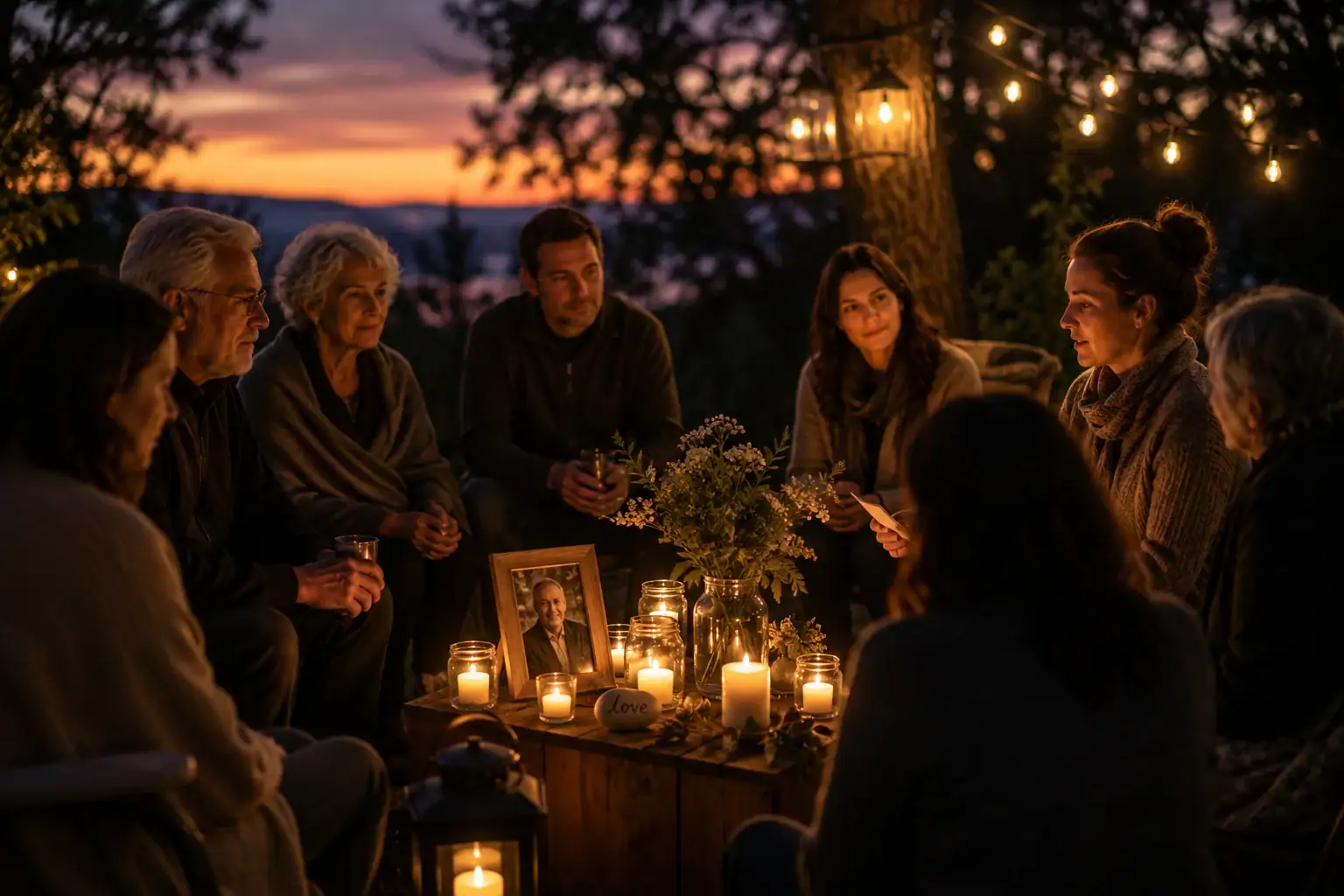
When Eleanor’s mother died in the fall, the family chose direct cremation and spent several weeks gathering themselves before holding a celebration in the family’s backyard on a mild December afternoon. They strung lights through the oak trees. Each of the twelve grandchildren read a line from a poem written specifically for their grandmother. Her three children each shared one story. The ceremony ran forty minutes, and then the family stayed for three hours, eating, laughing, and crying together around a fire.
“It was exactly her,” Eleanor told me later. “She would have hated anything stiff. This was her.”
🕯️ 2. An Intimate Home Memorial
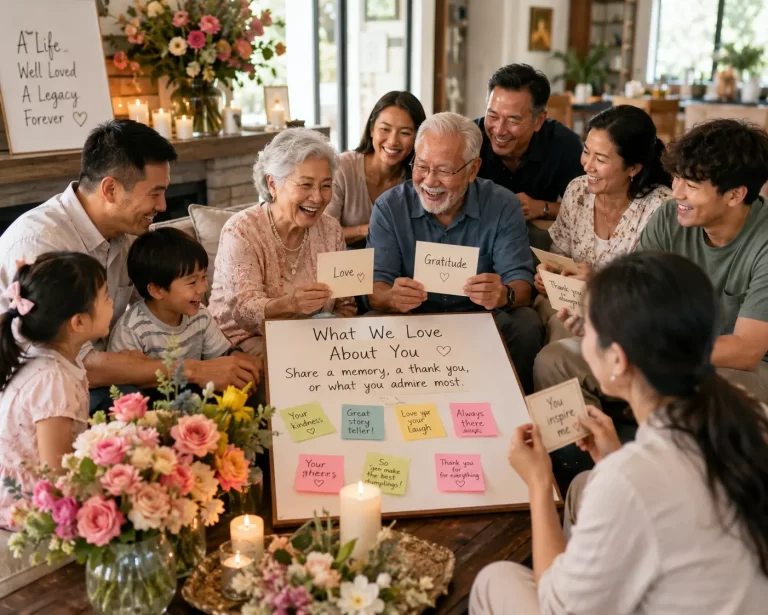
Not every family wants or needs a large gathering. Some of the most profound memorials I have witnessed held fewer than ten people in a living room. The intimacy is the point.
An intimate home memorial is ideal when:
- Your loved one was private and would have preferred a small gathering
- The immediate family needs to grieve together before opening to a wider circle
- Health, distance, or finances limit who can attend
- You want to honor your loved one without the social complexity of a large event
A home ceremony can include photos displayed around the room, meaningful objects on a small altar, candles, music, and a ceremony script delivered by a family member or a professional celebrant. The ashes may be present in a beautiful urn or scattering vessel.
What a Home Memorial Can Include
- A personalized welcome and opening
- A life tribute written around your loved one’s specific story
- Invited sharing from family members (guided, not open-ended)
- A reading — poetry, a passage, or words written for this ceremony
- A ritual moment: lighting a candle, sharing a rose, a moment of silence
- A meaningful close
You can deliver this ceremony yourself using a custom script, or have a celebrant present to hold and lead the gathering for you — so every family member can simply be there rather than managing the logistics.
🌊 3. An Ash Scattering Ceremony
For many families, the most meaningful farewell after cremation is returning the ashes to a place of natural beauty — a place that felt like home, or a place that holds what they believed about life.
An ash scattering ceremony transforms what could be a private, logistically awkward moment into a genuine ceremony of farewell. With a guide and a script, the scattering becomes a ritual — something witnessed, something spoken over, something remembered.
This is where ceremony and landscape work together in a way that nothing else quite matches.
A Gentle Return to the Land
For families in Marin County and the greater Bay Area, we offer a guided ash scattering service called A Gentle Return. Up to six guests gather at a beautiful location in the Marin Headlands, overlooking the Pacific. I lead a brief ceremony — words, ritual, and silence — as the family returns their loved one’s ashes to the earth and sea. It is small, intentional, and unhurried. Families consistently tell me it is the moment their grief shifted.
If you are not in the Bay Area, ash scattering is also possible to plan independently at a location meaningful to your family. The key is to bring ceremony to the moment — to not simply scatter and leave, but to gather, speak, and mark what has happened.
Federal and state regulations govern ash scattering in public lands and waterways. We help families navigate these requirements with care. Learn more about our ash scattering service here.
💻 4. A Virtual or Hybrid Memorial
One of the lasting gifts of recent years is the normalization of online gathering. A hybrid memorial — part in-person, part virtual — makes it possible for family and friends scattered across the country or the world to participate fully in honoring your loved one.
A virtual memorial works best when the ceremony is designed for it from the beginning, rather than treated as an afterthought. That means:
- Remote guests are given specific roles — a reading, a welcome, a closing prayer or blessing
- The script accounts for transitions between in-person and virtual speakers
- A “virtual altar” is prepared — a shared photo displayed on screen
- A parallel ritual is invited: “As we light this candle here, we ask those at home to light a candle in their space as well”
When designed well, virtual participation does not feel like a compromise. It can extend the gathering in ways a single-location ceremony cannot.
Hybrid Memorial Format (90 minutes)
- Opening (5 min): Welcome both in-person and virtual guests
- Life Tribute (15 min): Celebrant or family member shares the story
- Invited Sharing (20 min): 4–5 speakers, mix of in-room and virtual
- Ritual Moment (5 min): Candle lighting, parallel at home and in the room
- Music or Video Tribute (5 min): Shared on screen
- Closing Words (5 min): Final blessing or poem
- Open Sharing (30 min): Informal gathering, virtual guests may remain on screen
📖 5. A Legacy Storytelling Ceremony
Some families want more than a ceremony of farewell — they want an act of preservation. A legacy storytelling ceremony centers the telling and recording of your loved one’s story as the ceremony itself.
This format works especially well for:
- Elders whose life spanned remarkable historical periods
- Families with rich oral traditions or cultural histories
- People whose stories were never fully known to younger generations
- Families who want something that can be returned to, not just experienced once
A legacy ceremony might include elders sharing formative memories, younger family members asking questions they always wanted to ask, the reading of letters or journals, and a structured closing that names what this person’s life meant to each generation present.
Our legacy storytelling ceremony service includes extended consultation, multi-generational story weaving, and a comprehensive script that becomes a family heirloom — something your grandchildren will one day read.
Not Sure Which Approach Is Right for You?
Every family’s situation is different. A brief conversation can help you find the format that fits your loved one’s story, your family’s needs, and your timeline.
Schedule a Gentle Conversation Explore Memorial ServicesHow a Custom Ceremony Script Transforms Any of These
The single most common thing families tell me after a memorial ceremony is: “I didn’t know words could do that.”
There is a difference between a gathering where people share memories informally — wonderful as that is — and a ceremony with language that has been crafted specifically for this person, this family, and this loss. The difference is not subtle. It is the difference between a wake and a ceremony.
A custom ceremony script from RememberedWell is built through a personal story consultation — a conversation where I listen carefully to who this person was, what they loved, what they believed, and what their life meant. From that conversation, I write a script that includes:
- A personalized opening that grounds the gathering in this particular loss
- A life tribute written in specific, vivid detail — not generic memorial language
- Readings chosen or written for this ceremony
- A ritual moment shaped for your family
- Clear delivery notes so any family member can present the ceremony with confidence
- A closing that sends people home carrying something
Scripts are available for families who will deliver the ceremony themselves, and for families who want a professional celebrant to lead the gathering — available in person throughout the Bay Area.
A Note on “No Fuss” Wishes
Many people who choose direct cremation also say they want “no service” or “nothing formal.” If this is what your loved one expressed, you are not obligating them by creating a ceremony after the fact. A ceremony is a gift from the living to themselves and to each other. You can honor both your loved one’s desire for simplicity and your own need to grieve — through a ceremony that is small, personal, and utterly free of anything stiff or performative.
The Gift of an Ash Scattering Ceremony
If your family is holding cremated remains and feeling uncertain about what to do with them, an ash scattering ceremony may be the answer — and it is one of the most profound memorial experiences available.
The Marin Headlands, overlooking the Golden Gate and the Pacific Ocean, offers some of the most breathtakingly beautiful landscape in California. For families in the Bay Area — or those willing to travel to this coast — our A Gentle Return service brings a small gathering (up to six guests) to this landscape for a guided ceremony of farewell.
What distinguishes a guided scattering ceremony from simply spreading ashes on a hillside is the ceremony itself — the words spoken, the silence held, the moment marked. Families leave feeling that something real has happened, something they did together, something they will carry.
The service includes:
- A personal consultation to understand your loved one’s story
- A custom ceremony led by a certified celebrant
- Guidance on urn selection and preparation
- Timing and logistics coordination
- A moment of intention, ritual, and closing before you leave the site
A Gentle Return is offered Monday through Friday, 11 AM to 1 PM, and is priced at $750. Learn more and inquire here.
How to Get Started
If you are holding cremated remains right now and feeling the weight of not knowing what to do next, here is a simple path forward.
Step 1 — Give yourself permission to take time.
There is no deadline for a memorial. Families often wait two to six weeks, or longer if travel is involved. The ashes will keep. Your grief is patient. You do not have to act this week.
Step 2 — Decide on the form.
Review the five approaches above and notice which one feels most like your loved one. Which one feels most like your family right now? You do not have to choose one — some families do a small home ceremony and a scattering ceremony months apart.
Step 3 — Reach out for support.
A short conversation is all it takes to begin. We will talk about your loved one, your family’s needs, and what kind of ceremony would honor both. From there, we write — and then you have something in your hands that you can use.
Step 4 — Let the ceremony do its work.
Show up. Say the words. Let people cry. Let people laugh. Let the ceremony hold what needs to be held. This is what ceremony was made to do.
Ready to Honor This Life?
Whether you need a celebration of life script, an ash scattering ceremony in Marin, or simply someone to talk to about what comes next — we are here. Every ceremony begins with a conversation.
Begin a Tribute Explore Memorial ServicesQuestions We Often Hear
Do I need a ceremony if my loved one chose direct cremation?
There is no legal or logistical requirement. But research on grief consistently shows that ritual helps the living process loss. A ceremony — even a small, informal one — creates a container for grief, gives mourners a chance to gather, and honors your loved one’s story in a way that simply receiving ashes does not.
How long after direct cremation should we hold a memorial?
There is no rule. Many families hold a memorial within two to four weeks of the death. Others wait for a meaningful season or anniversary, especially if family is scattered. What matters is that the timing feels right for your family, not that you meet a cultural deadline.
What is an ash scattering ceremony?
An ash scattering ceremony is a gathering — often in a meaningful outdoor location — where family and close friends return cremated remains to the natural world. A ceremony officiant or family member leads the gathering with readings, shared remembrances, and ritual. In California’s Marin County, we offer a guided ash scattering service called A Gentle Return in the Marin Headlands.
Can I hold a meaningful memorial at home?
Absolutely. Some of the most moving memorial ceremonies happen in living rooms, backyards, and around kitchen tables. What makes any space sacred is the intention you bring to it. A custom ceremony script gives structure and language to an intimate home memorial, even when the family delivers the ceremony themselves.
What does a custom ceremony script include?
A RememberedWell custom ceremony script is built from a personal story consultation and typically includes a personalized opening, readings, a life tribute written around your loved one’s specific story, a ritual moment, and a meaningful closing. Scripts include delivery notes so any family member can present with confidence.
How do I include people who can’t travel to a memorial?
A hybrid memorial works beautifully. Set up a laptop or tablet so remote guests join via video call, and design moments specifically for them — a reading they deliver from home, a candle they light in parallel, or a recorded video tribute. Your ceremony script can be written to include these remote moments naturally.
What if my loved one said they didn’t want a service?
This is one of the most tender questions families face. It helps to remember that a memorial ceremony is for the living as much as for the person who died. A quiet, personal ceremony that honors that spirit — no big production, just presence — can respect both the deceased’s wishes and the family’s need to grieve.
How much does a custom memorial ceremony script cost?
Our Essential Ceremony Script — which includes a personal story consultation, a complete custom-written script with delivery notes, and one round of revisions — is $350. For families who want a professional celebrant to deliver the ceremony in person in the Bay Area, our Complete Ceremony Experience begins at $750. View full pricing here.
Continue Reading: The Water Cremation Series
If you are in the early stages of planning end-of-life arrangements, you may also be exploring alternative cremation options. Our ongoing series covers aquamation (water cremation) in depth — including providers in Northern California, what the process involves, and how families are incorporating these choices into meaningful farewell ceremonies.